
Resetting the Table: Announcing School Food Alberta
Across Canada, provinces are building school food into essential public infrastructure. Most Alberta schools cannot offer a regular hot lunch. School Food Alberta is a new non-profit designed to connect schools, their boards, public funding, and local meal providers into one reliable system, making good meals easier for schools to offer and easier for every child to access.
I moved to Calgary in Grade 4 to study at the same public elementary school my dad attended growing up. For the following three years, my family rotated me between three lunches: powdered Lipton chicken noodle soup, canned Campbell’s Italian wedding soup, and Campbell’s Chunky beef stew. We could afford a good lunch, yet I still did not get one. Packing a lunch every morning was something my parents never had time for, and these were the options that worked for our family.
This was a surprising adjustment because I had come from Hong Kong, where I was lucky enough to attend a school with a built-in cafeteria. For under five CAD dollars/day, I could order a rice or noodle bowl with protein and vegetables, dumplings on the side and, occasionally, a carton of milk. When I moved to Canada, it had never occurred to me that lunch simply would not be available at school. There wasn’t even a cafeteria–we ate at makeshift tables set up in the gymnasium or along the hallway.
What I did not understand back then was that this was the reality at most Albertan schools, and that the lack of infrastructure reflected a much larger difference in how we think about feeding children.
Despite Alberta having the highest median after-tax income among the provinces, most schools don’t offer a lunch program; students are generally expected to pack lunch from home. Before the recent federal funding, Alberta's School Nutrition Program (SNP) primarily focused on low income families, and served approximately 58,000 students. Total K-12 enrollment in the province reached ~835,000 students in December 2025–meaning just shy of 7% of students accessed the SNP. Within this 7%, only a minuscule fraction includes a hot lunch; the SNP is mostly breakfast (usually an apple, yogurt, cheese string), pre-packaged snacks (granola bar), and occasionally sandwiches supplied by local non-profits.
Over the past two months, my goal was to understand why Alberta has not turned its considerable resources into a functioning province-wide school-food system by speaking with leaders and operators across Canada’s school-food ecosystem. In Alberta alone, I contacted nearly 250 schools and principal offices, spoke with 5 public school authorities, and interviewed more than 20 non-profit and for-profit food businesses. I also exchanged findings with examples of other organizations across Canada: the Coalition for Healthy School Food, the Alberta School Food Community of Practice, Ontario’s School Food Lead Agencies, La Cantine pour tous (Quebec), Nova Scotia School Lunch Program, The Child Nutrition Council of Manitoba, and the PEI School Food Program, as well as people with decades of experience operating school-food programs in the United States.
After these conversations, six findings came through clearly:
Full cafeterias and on-site kitchens are the best way to make school food part of daily school life—but Alberta schools were not built that way. Full cafeterias and on-site kitchens are the strongest long-term model because they make school food part of daily school life. But most Alberta schools were not built that way, and retrofitting hundreds of buildings will take years. We should hold this long term vision and invest in that future without making children wait for it now. In the meantime, Alberta needs a safe off-site model that uses qualified kitchens and gives schools clear processes for receiving and serving meals.
Schools want better food, but they should not have to become food-service operators. Schools understand their students and must remain essential partners, yet it makes little sense to expect already-stretched principals/staff/teachers to become procurement specialists, logistics coordinators, menu planners and payment administrators. Authority also differs significantly across Alberta: some school systems allow more school-level discretion, while others centralize recurring programs and vendor relationships. When each school or authority must solve the operating problem independently, inconsistency is almost inevitable.
Alberta has a coordination problem. Community organizations, educators, volunteers, charities, food banks, and other ad-hoc local programs are already feeding children with creativity and care. But everyone operates under different school authority rules, with inconsistent funding, and very different access to staff, facilities, and administrative support. Some schools can work directly with providers; others need board approval or must use an existing partner. A school may want hot lunch and still have no clear route to start. A provincial system would give every school a clearer path to approved providers, dependable funding, and consistent service while still allowing communities flexibility to deliver approaches tailored to local needs.
The production capacity exists, but the route into schools does not. Almost every provider I spoke to was enthusiastic about the potential of serving recurring, hot meals to schools and stated they had the production and delivery infrastructure to do so. However, the foremost barrier was around becoming an approved provider. Kitchens often do not know which standards they must meet, who can authorize them, or how to move from readiness to a school contract. Even already-approved providers stated their need for predictable demand, fair contracts, shared standards, coordinated delivery, efficient ordering, and reliable payment. Alberta has non-profit kitchens, food businesses, and food-service professionals ready to participate in school food; what is missing is the scaffolding that lets them do so.
Universal access should mean that every child can participate without stigma and receive food that is nourishing, appealing, and culturally appropriate. That includes families who do not qualify for targeted support but may willingly pay if a good program existed. Pay-what-you-can models in British Columbia, Quebec, Nova Scotia, and Prince Edward Island have proven approaches where every family can opt in, contribution choices remain private, and public funding protects access. In 2023-24, parents using Quebec’s La Cantine pour tous paid an average of $3.26 per meal, demonstrating meaningful family participation within a universal model.
More money matters, but money alone will not build the system. In 2026-27, $17.6 million in federal funding is being added to Alberta’s existing $20 million annual School Nutrition Program allocation. That combined investment is an opportunity not only to expand existing programs, but to rethink how Alberta organizes and delivers school food. With significant new funding entering the system, this is the right moment to invest in the shared infrastructure for local food systems needed to test a more ambitious province-wide model—one that can determine whether complete, appealing hot meals can be delivered safely, at a fair cost and at a scale that can grow in both urban and rural settings. A serious investment now can create the evidence and operating capacity needed to attract and sustain future funding.
As one of Canada’s wealthiest provinces, Alberta has substantial household purchasing power alongside significant public investment. Many parents are willing and able to pay for a good school lunch, but at many schools they are not given a reliable, appealing option to do so. The unmet need is therefore not only an affordability gap; it is also a coordination and market-access gap. Public investment can build the shared infrastructure, standards, and access guarantees the system requires, while family participation creates dependable demand and brings additional resources into local school food.
The structure I keep returning to looks like this:
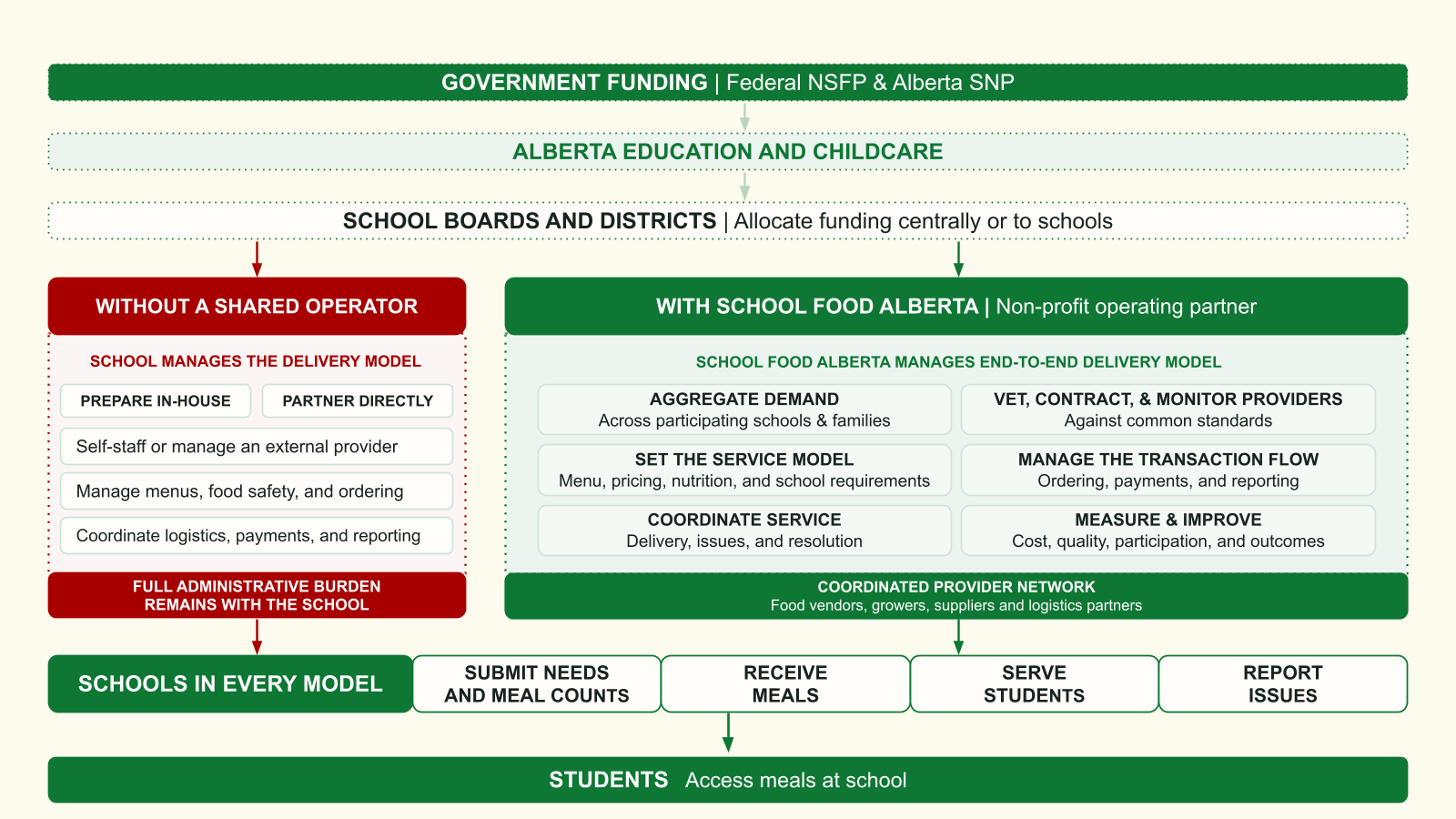
Where School Food Alberta is the dedicated non-profit managing the shared layer between schools, public funding, and meal providers. The government provides funding to keep school meals accessible.School authorities remain accountable for students and approve participation. School Food Alberta qualifies providers, coordinates standards and menus, and manages ordering, payments, logistics, and reporting. Local kitchens prepare and deliver the food, while schools define their needs and stay focused on education.
We make good hot meals easier for schools to offer and easier for every child to access. As such, we are building the connective infrastructure that schools and kitchens do not have capacity to build alone. Our long-term goal is to make Alberta’s school food system function as one network rather than a series of isolated programs, and give future public investment somewhere accountable to go.
Our first priority is a province-wide platform for managing orders, payments, and reporting across schools and meal providers. We are early in this work, and we have not solved every part of it. Building the system will require government, school authorities, non-profits, food banks, businesses, parents and food-service professionals to work across private-public boundaries. I want to hear from the people who want to, and will make it work.
- Parents: If your child’s school offered an optional hot lunch with confidential pay-what-you-can pricing, what would your family typically be comfortable contributing per meal?
- Meal providers: what economics and infrastructure would make school meals viable for you?
- Schools: do you want to offer a hot lunch program, and what stands between that goal and a program that works?
- Funders: are you interested in helping build and prove a practical, province-wide approach to school food in Alberta?
- Government: what would it take to build an Alberta school-food system that supports children’s learning now—and their health for life?
Alberta already has most of the ingredients required to feed children well. School Food Alberta’s mission is to connect schools, funding, and meal providers into one reliable system that reaches every child.
Ready to help build it? Share what you know, what you need, or what you can contribute at hello@schoolfoodalberta.ca.
Appendix 1: What Alberta can learn from elsewhere
After years as the only G7 country without a national program, Canada committed $1 billion over five years to the National School Food Program in 2024. The urgency has only grown: according to the 2023 Canadian Income Survey, 32.9% of children under 18 in the provinces lived in food-insecure households.
Within Canada, provinces already show that school food is not constrained by a single operating model. In its first year, Nova Scotia’s pay-what-you-can lunch program served more than 4.7 million lunches across 258 schools; by 2025-26, it had expanded to 334 schools and more than 104,000 eligible students. Quebec has built a shared network of nonprofit and social-economy meal providers, while Prince Edward Island moved day-to-day delivery into a dedicated nonprofit without withdrawing government funding or schools from the system. In each case, the public objective is paired with deliberate operating capacity.
Brazil shows how school-food purchasing can also be economic policy. Its national program now requires at least 45 per cent of federal school-food funds to be spent on food bought directly from family farmers. Alberta need not copy that rule, but there is precedent around how predictable public demand can nourish children while strengthening local producers.
Japan shows what changes when lunch is treated as part of education rather than an interruption to it. Japan’s Ministry of Education describes school meals as a teaching tool for food knowledge and healthy habits, supported by nutrition teachers and learning about local food. The lesson for Alberta is cultural as much as operational, where a mature system makes lunch part of ordinary school life instead of charitable exception.
Taken together, these cases point toward the same design principles: keep the public purpose and accountability clear, build specialized operating capacity, use procurement deliberately, and make a good meal an ordinary part of the school day.
For a broader survey, see the Coalition for Healthy School Food’s international collection of school-food programs.
Appendix 2: A Network, not a Provider.
School Food Alberta is envisioned as a coordinating non-profit governed with the organizations that deliver school food. Its role would not be to replace local kitchens or centralize meal production. Members would continue preparing food within their communities while gaining access to shared technology, procurement support, menu and nutrition resources, training, funding opportunities, and a collective voice.
This approach follows the broad logic of La Cantine pour tous, where independent local organizations act together at provincial scale. Members retain their own identities and missions while participating in the formal organizational governance of the network that connects them.